


![[pdf]](icons/pdf.png)
|
|
|
|
| Local seismic attributes | |
|
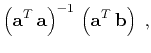
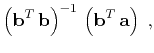
In a linear algebra notation, the squared correlation coefficient
 from equation 8 can be represented as a
product of two least-squares inverses
from equation 8 can be represented as a
product of two least-squares inverses
 is a vector notation for
  ,
,  is a
vector notation for
is a
vector notation for  , and
, and
 denotes the
dot product operation. Let
denotes the
dot product operation. Let  be a diagonal operator
composed from the elements of and
be a diagonal operator
composed from the elements of and  be a
diagonal operator composed from the elements of .
Localizing equations 10-11 amounts to adding
regularization to inversion. Scalars
be a
diagonal operator composed from the elements of .
Localizing equations 10-11 amounts to adding
regularization to inversion. Scalars  and
and  turn
into vectors
turn
into vectors  and
and  defined, using shaping regularization , as
and . It is
interesting to note that, if one applies an iterative
conjugate-gradient inversion for computing the inverse operators in
equations 12 and 13, the output of the first
iteration will be the smoothed product of the two signals
defined, using shaping regularization , as
and . It is
interesting to note that, if one applies an iterative
conjugate-gradient inversion for computing the inverse operators in
equations 12 and 13, the output of the first
iteration will be the smoothed product of the two signals
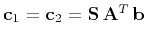 ,
which is equivalent, with an appropriate choice of
,
which is equivalent, with an appropriate choice of  , to the algorithm of fast local cross-correlation
proposed by Hale (2006).
, to the algorithm of fast local cross-correlation
proposed by Hale (2006).
The local similarity attribute is useful for solving the problem of
multicomponent image registration. After an initial registration using
interpreter's ``nails'' (DeAngelo et al., 2004) or velocities from
seismic processing, a useful registration indicator is obtained by
squeezing and stretching the warped shear-wave image while measuring
its local similarity to the compressional image. Such a technique was
named residual scan and proposed by Fomel et al. (2005).
Figure ![[*]](icons/crossref.png) shows a residual scan for registration of
multicomponent images from Figure . Identifying and
picking points of high local similarity enables multicomponent
registration with high-resolution accuracy. The registration result is
visualized in Figure , which shows
interleaved traces from PP and SS images before and after
registration. The alignment of main seismic events is an indication of
successful registration.
shows a residual scan for registration of
multicomponent images from Figure . Identifying and
picking points of high local similarity enables multicomponent
registration with high-resolution accuracy. The registration result is
visualized in Figure , which shows
interleaved traces from PP and SS images before and after
registration. The alignment of main seismic events is an indication of
successful registration.
|
|
|
|
| Local seismic attributes | |
|




![$\displaystyle \left[\lambda^2\,\mathbf{I} +
\mathbf{S}\,\left(\mathbf{A}^T\,\...
...bda^2\,\mathbf{I}\right)\right]^{-1}\,
\mathbf{S}\,\mathbf{A}^T\,\mathbf{b}\;,$](img49.png)

![$\displaystyle \left[\lambda^2\,\mathbf{I} +
\mathbf{S}\,\left(\mathbf{B}^T\,\...
...bda^2\,\mathbf{I}\right)\right]^{-1}\,
\mathbf{S}\,\mathbf{B}^T\,\mathbf{a}\;.$](img51.png)